Customer Service Automation: The 2026 Playbook (With Real Numbers)
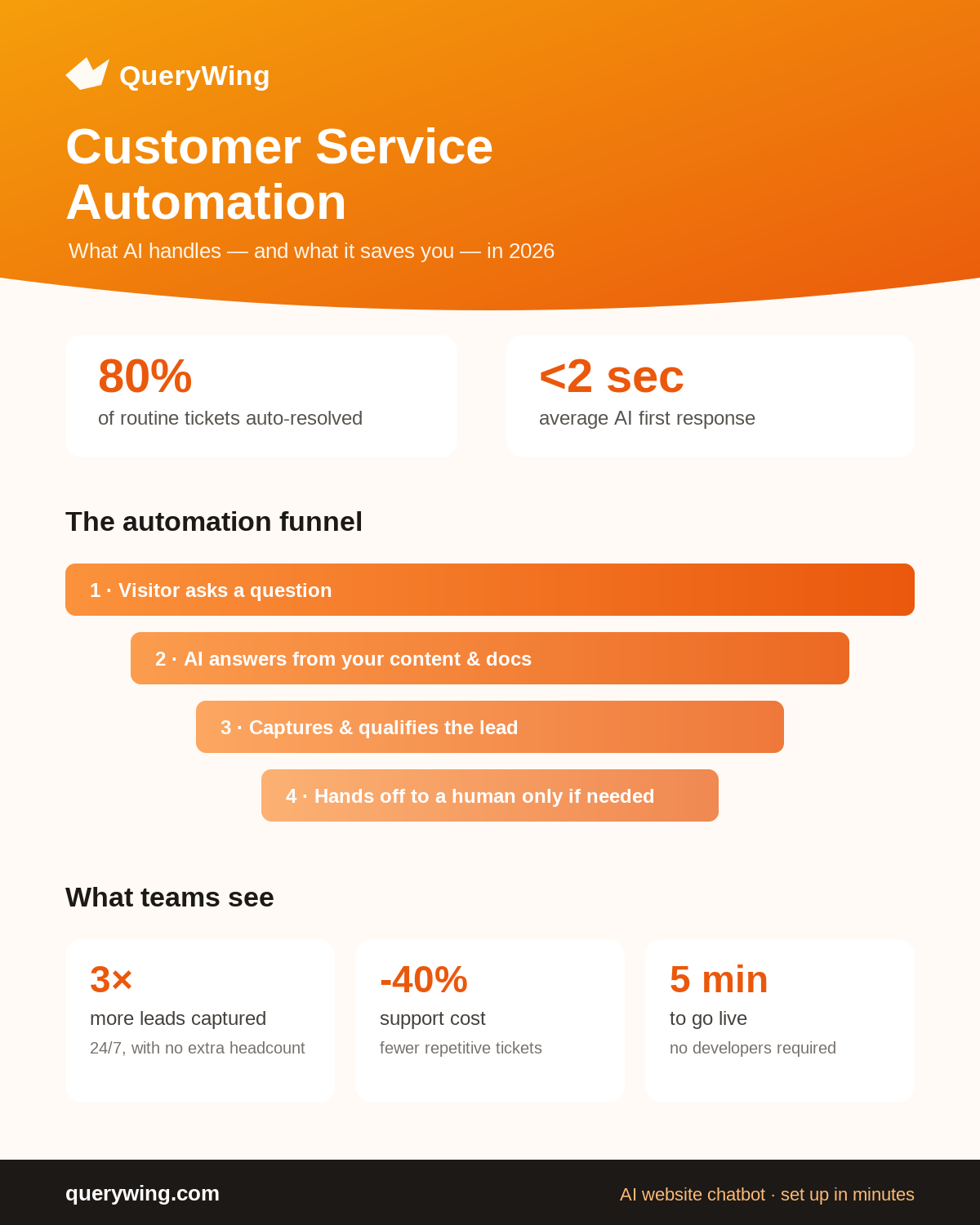
Customer service automation uses AI to answer routine customer questions instantly, 24/7, capture and qualify leads, and hand off to a human only when a conversation truly needs one. Done well, it resolves up to 80% of repetitive tickets, cuts support costs, and improves response times — without making customers feel like they are talking to a wall.
This is the practical 2026 playbook: what to automate, what to keep human, the numbers to expect, and how to roll it out.
What "customer service automation" actually means in 2026
A few years ago, "automation" meant clunky decision trees and canned macros. In 2026 it means an AI assistant trained on your content — website pages, help docs, PDFs, and FAQs — that understands a question in plain language and answers it accurately.
The modern stack has three layers:
What to automate first
Start where volume is high and answers are stable:
Keep humans in the loop for refunds and disputes, angry or emotional customers, and anything that requires judgment or an exception.
The numbers: what automation is worth
The business case is not subtle. Teams that automate the repetitive layer typically see:
The hidden win is consistency: every customer gets the same accurate answer at 2pm or 2am.
A 5-step rollout
Keep it human where it counts
The brands that win with automation are not the ones that hide the humans — they are the ones that use AI to get customers to the right answer (or the right person) faster. Make it obvious how to reach a human, and hand off gracefully with context so customers never repeat themselves.
Get started
QueryWing is an AI website assistant that automates the repetitive layer, captures leads 24/7, and hands off to your team — live in minutes on a free plan. Explore the [website chatbot](https://querywing.com/features/website-widget) or see [how it compares to live chat](https://querywing.com/vs). If you run a small team, start with our guide to the best [AI chatbot for small business](https://querywing.com/chatbot-for-small-business).
Frequently asked questions
What is customer service automation?
Customer service automation is the use of software — primarily AI chatbots and workflows — to handle customer questions and support tasks without a human agent. Modern AI answers from your own content, captures and qualifies leads, and escalates to a person only when needed.
How much of customer service can be automated?
For most businesses, AI can fully resolve 60–80% of routine, repetitive questions (order status, pricing, how-to, hours, policies). The remaining complex or emotional cases are handed off to human agents with full context.
Does automation replace human support agents?
No. The goal is to let AI absorb repetitive volume so your team focuses on high-value, nuanced conversations. Most teams redeploy agents to retention and complex cases rather than cutting headcount.
How long does it take to set up?
With a modern tool like QueryWing, most businesses are live in under five minutes: add your website or documents, customize the widget, and paste one line of code. No developers required.